 Customer story · Robot for Hire
Three weeks from remote control to an autonomous humanoid.
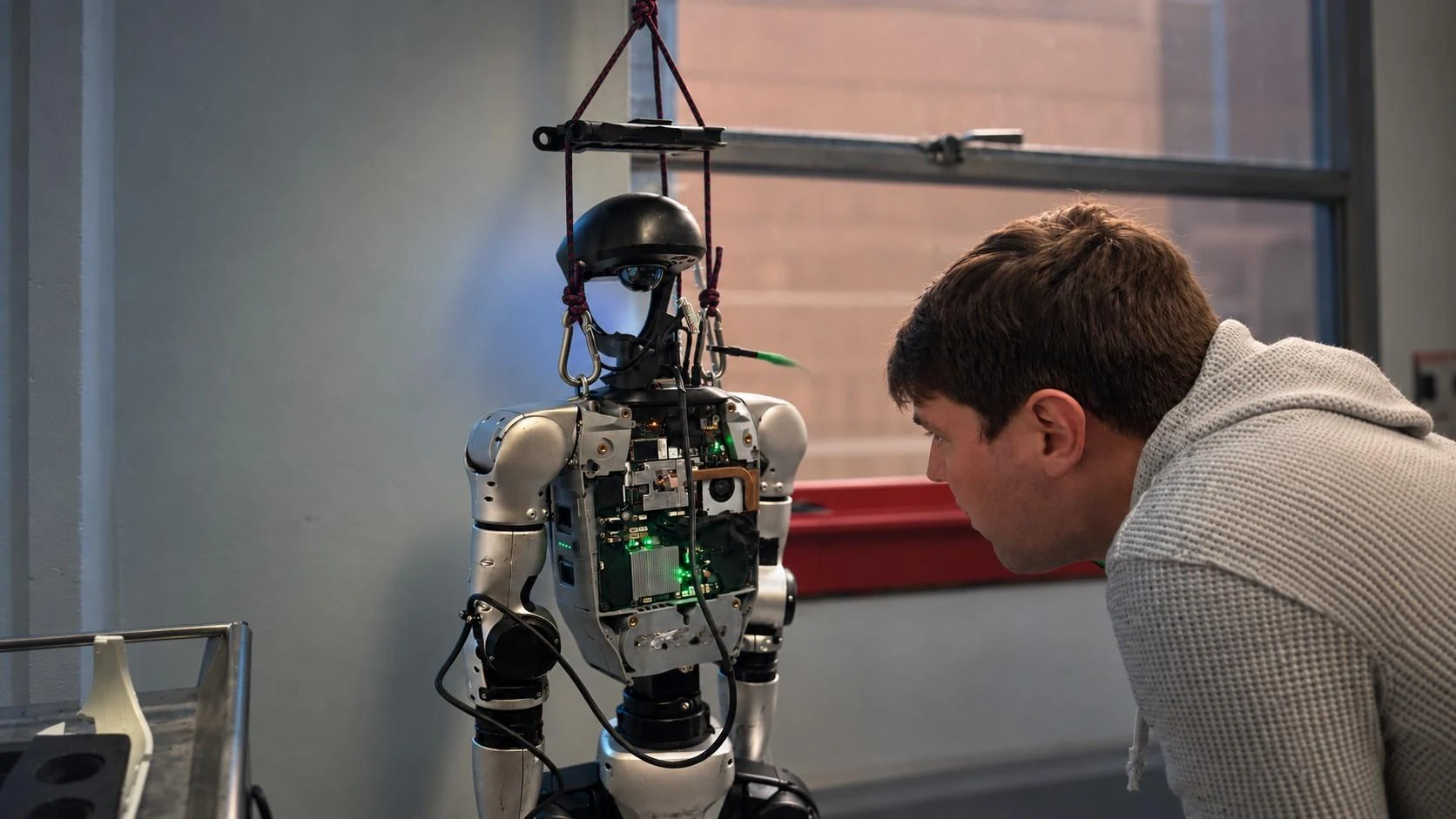
Robot for Hire puts humanoids in front of Fortune 500 audiences, not in a lab. Their Unitree G1, Rocco, moved onto Admiral in a day. Over the next three weeks the team built the perception and navigation that now walks it through a crowd with nobody on the controller.
- Hardware
- Unitree G1 humanoid, two onboard computers
- What runs on Admiral
- The development computer: perception, navigation and the custom VLA stack
- Build and deploy
- Docker image from CI, rolled out with automatic rollback
- Debugging
- Logs pulled by their coding agent through the Admiral MCP server
- Migration to first demo
- 1 day
- Remote control to semi-autonomous
- 3 weeks
Before Admiral
The team's time went into the layer under the robot.
The company's internal shorthand is "before Admiral and after Admiral". Before, the work was not the robot.
Six-year-old vendor software under everything.
The humanoid shipped with the manufacturer's stock software and drivers. Getting at the lidar, or at anything low level, meant fighting an outdated driver before a single feature could be written.
Every robot slightly different.
Two units of the same model carried different software versions and joint calibrations, so putting a known-good build on a second robot was never a copy.
Rollbacks by hand.
Going back to an image that had worked meant doing it manually and keeping track of which one that was.
An operator on every interaction.
Rocco needed a person on the controller for the whole of every event, because the stack to let it act on its own could not be built while the team was busy underneath it.
 After Admiral
The same team, building the robot.
Robot for Hire built the autonomy. Admiral removed the work that had been standing in the way of it, and gave them a way back when a build went wrong.
The low-level work is gone.
Admiral runs the robot's second computer, the one the team builds on. Kernel, drivers and hardware access are handled below the container, so the engineering hours go into perception and behaviour.
A feature a day, with a way back.
A new build is a Docker image and a rollout. If it breaks on the robot, the team rolls back to the previous image and carries on. In Sammo's words, they now take risks they would not have taken before.
Bug to deployment in ten minutes.
When something goes wrong, their coding agent pulls the robot's logs through the Admiral MCP server, works out what happened, fixes it and ships the fix. Severe faults page a human; the rest resolve in the loop.
Semi-autonomous in three weeks.
Rocco now sees people, avoids obstacles, checks clearances and follows someone through a crowd without an operator on the sticks. Robot for Hire wrote all of that themselves, on top of Admiral.
In his words
Sammo, founder.
Founder of Robot for Hire, speaking with us in Sydney a few weeks after moving Rocco onto Admiral.
"Instead of focusing on the hardware and the software and churning out new features, I was just fighting with the stack, fighting with the driver. Everything low level has been taken care of now, so I can ship what actually makes an impact."
"Instead of wasting weeks, we can ship a new feature a day. If the feature breaks, we just roll back the image and everything is as normal. We are taking riskier steps than we would have before."
"From catching a bug to deployment, it is ten minutes away."
"There is one dashboard and version control of the image itself. If I want to go back to an old image that was working, I just roll back. I used to do that by hand and it was hard to keep track of. It made our deployment ten times faster."
How a feature ships
From a prompt to the robot, and back.
Write
A coding agent writes the change.
Most of Robot for Hire's development is agent-driven. The code lands in their repository and CI builds a Docker image, as it would for any service.
Ship
Admiral rolls it onto Rocco.
The image goes to the robot over its own outbound connection. The previous image stays on the other slot.
Watch
The agent reads the logs.
An automation checks the last hour of logs through the Admiral MCP server. Anything severe pages a person.
Fix or revert
Fix forward, or roll back.
A fix ships the same way in minutes. If the build is wrong, the team rolls back to the image that worked and the robot is back at the event.
Boundary
What Robot for Hire owns, and what Admiral owns.
- Theirs: the perception, navigation and interaction stack, the custom VLA models, the operator tooling in the browser, and the robot itself. All of it ships as their own container image from their own CI.
- Admiral's: the operating system on the development computer, hardware access to the lidar and cameras, the A/B image slots and rollback, remote access with no inbound ports, and the logs their agent reads.
- Unchanged: the manufacturer's locomotion controller on the first computer. Admiral sits beside it, not over it.
Your robot
Put one spare robot on Admiral this week.
Start free with 5 devices, or talk to sales about the fleet you are about to ship.